School-age children wash their hands more than almost any population outside of healthcare. For children with allergies and sensitive skin, that frequency is not a hygiene benefit. It is a documented clinical risk factor playing out across every school day, which is exactly why a truly hypoallergenic hand soap can make frequent washing safer, gentler, and more sustainable for their skin.
What we discovered after our daughter started school:
School soap dispensers are refilled with whatever is cheapest — not whatever is safest
The same hands washing off lunch are washing off skin barrier lipids with every cycle
NIH research confirms 8 to 10 daily washes raises hand eczema risk by 51% — school-age children hit that number before dismissal
"Hypoallergenic" on any soap label has never required a single clinical test to print
We were sending our daughter into a building where the hand hygiene protocol was actively working against her skin
This page covers what two years of formulation research, independent Swiss laboratory testing, and raising a child with allergies in a school environment taught us about what safe and effective hand hygiene actually requires — and why the answer looks nothing like what is currently in most school bathrooms.
We are Dr. Ruslan Maidans and Dr. Yalda Shahriari — a dentist and a biomedical engineer who built NOWATA because our daughter needed it and it did not exist. What follows is everything we wish her teachers and school nurses had known before she walked through those doors.
TL;DR Quick Answers
Is Hypoallergenic Hand Soap Safe for School-Age Children With Allergies?
Not automatically — and the school bathroom is where that distinction matters most.
What most parents don't know until it's too late:
"Hypoallergenic" has no federal regulatory definition — any brand can use it without a single test
School soap dispensers are bulk procurement decisions — not allergy safety decisions
Nearly 1 in 4 school-age children has a documented allergy
Peak eczema prevalence occurs in children ages 6 to 11 — the highest mandatory handwashing years
Fragrance — the number one contact allergen in children — is present in most school soap dispensers right now
What we learned after our daughter started coming home with red, irritated hands every day:
We had managed her allergies carefully at home with products we had researched and trusted
A school soap dispenser undid all of it by dismissal
The soap carrying every hypoallergenic claim available contained SLS, synthetic fragrance, and parabens
The label was a procurement decision — not a clinical one
What genuinely safe looks like for allergic school-age children:
Fragrance-free, SLS-free, alcohol-free, paraben-free, and dye-free
pH-balanced between 4.5 and 5.5
No wet-dry cycle — eliminates the trigger compounding barrier damage across every school-day wash
Independently verified by third-party laboratory testing — not self-declared
Portable — accessible at every handwashing point without the school dispenser
The school bathroom dispenser is outside your control. What your child carries into it is not. Until schools are required to provide verified allergy-safe alternatives, the answer is what goes in the backpack — independently verified, tested on our own children first, and trusted before anyone else's child uses it.
Top Takeaways
The school bathroom soap dispenser is one of the most overlooked allergy triggers in a child's daily environment.
Nearly 1 in 4 school-age children has a documented allergy
Peak eczema prevalence: children ages 6 to 11 — the highest school attendance years
Bulk institutional soap is a cost procurement decision — not a safety one
No federal requirement exists for schools to provide allergy-safe hand soap
No ingredient disclosure required at school dispensers
We managed our daughter's allergies carefully at home
A school bathroom soap dispenser undid all of it by dismissal
School-day handwashing frequency is a documented clinical risk factor — not just a comfort concern.
NIH research: 8 to 10 daily washes raises hand eczema risk by 51% — regardless of soap type
School-age children reach that threshold before the school day ends
Each wash compounds the barrier damage of the one before it
Gentler formula addresses chemical irritation — not mechanical barrier damage across six daily wash-and-dry cycles
We stopped asking which soap was safer when we understood frequency itself was the problem
Fragrance — the leading cause of contact dermatitis in children — is present in most school soap dispensers right now.
Allergic contact dermatitis affects 14.5% to 20% of children
Fragrance is the number one contact allergen in children
One "parfum" entry conceals 50 to 100 individual undisclosed chemical compounds
SLS and parabens appear in virtually every bulk institutional soap we reviewed
A child with a documented fragrance allergy has no guaranteed protection in a school bathroom
We were sending our daughter into a building where the leading childhood contact allergen was in every soap dispenser she used
"Hypoallergenic" on any label — including school soap — has never required a single clinical test to print.
FDA has no regulatory definition for "hypoallergenic," "gentle," "allergy tested," or "pediatrician approved"
Any manufacturer can use every one of these terms without proof
We trusted all of them for our own daughter
Her skin reacted to products carrying every claim simultaneously
The label is a business decision — the ingredient list is the only honest part of the bottle
The only reliable verification is independent third-party lab testing with a named protocol
The only reliable protection for an allergic child in an institutional setting is a verified alternative they carry themselves.
School bathroom dispensers are outside parental control — their contents are not
Portable verified fragrance-free waterless formula gives allergic children safe hand hygiene at every point in the school day
No wet-dry cycle — no mechanical barrier damage compounding across school-day washes
Physical germ removal — nothing left on skin to transfer or continue irritating
Swiss lab ASTM E1174 testing confirmed: 99.9% removal of bacteria and viruses
No compromise on clean
We built NOWATA because our daughter needed something she could carry herself
Verified before anyone else's child used it
Tested on our own children first — and still is
Most parents spend hours researching soap for home. Almost none think about what their child is washing with at school.
What is typically in a school soap dispenser:
Bulk institutional soap purchased on lowest-bid contracts
Formulas containing SLS, synthetic fragrances, alcohol, and artificial dyes
Products carrying no independent verification for sensitive skin safety
Refilled without regard for allergic reactions or skin conditions among the student population
What we found when we started asking questions after our daughter's hands started reacting:
School soap dispensers are procurement decisions — not health decisions
No federal standard requires schools to provide hypoallergenic soap
Children with documented skin allergies wash alongside everyone else with the same formula
The building designed to keep our daughter safe was using products that triggered her skin daily
The uncomfortable reality:
School-age children wash their hands 6 to 10 times per school day at minimum
Each wash with an irritating formula compounds barrier damage from the previous one
By dismissal, a child with allergies has experienced more sensitizer exposure at school than at home
Parents control what goes on their child's skin at home — and almost nothing that touches it at school
What Happens to Allergic Skin During a School Day
Understanding the damage requires understanding the timeline.
What a typical school day looks like for a child with skin allergies:
Morning arrival: hand washing with institutional bulk soap — first sensitizer exposure of the day
Before lunch: second wash — barrier begins showing cumulative stress
After lunch: third wash — natural oils stripped progressively with each cycle
After recess: fourth wash — physical activity increases skin temperature and absorption rate
After art or science class: fifth wash — additional chemical exposure from classroom materials
Before dismissal: sixth wash — skin barrier at its most compromised point of the day
What that cycle does to allergic skin specifically:
Each wet-dry cycle strips the lipid barrier protecting skin from environmental allergens
Compromised barrier allows allergen penetration between handwashing events
Repeated sensitizer exposure across multiple daily washes raises cumulative reaction risk
NIH research confirms 8 to 10 daily washes raises hand eczema risk by 51% — school-age children reach that threshold before the school day ends
What we saw in our own daughter:
Hands that left home intact returned red, dry, and irritated
Reactions we had managed carefully at home were undone by a single school day
Every product decision we had made for her skin was overridden by a bulk soap dispenser she had no control over
What Ingredients in School Soap Trigger Allergic Reactions
As a biomedical engineer and a dentist, we pulled the ingredient lists on the most commonly used institutional hand soaps. What we found was not surprising — but it was clarifying, in the same way hard surfaces in garden design reveal what’s really shaping the environment beneath the surface.
The most common sensitizers appearing in school soap formulations:
SLS — sodium lauryl sulfate — strips the skin barrier and increases transepidermal water loss with every wash
Synthetic fragrances — "parfum" entries concealing dozens of undisclosed chemical compounds
Alcohol and ethanol — compounds barrier damage with repeated daily use
Parabens — preservatives with documented sensitization potential
Artificial dyes — no functional benefit, measurable irritation risk for reactive skin
Alkaline pH above 6 — disrupts the acid mantle protecting skin between washes
What makes school soap specifically problematic for allergic children:
Institutional formulas prioritize cost and lather performance — not skin safety
No independent verification is required before bulk soap enters a school dispenser
Children with documented allergies have no alternative — they use what is available or they do not wash
The choice between allergic reaction and skipping hand hygiene entirely is not a choice any child should face
What we built NOWATA to eliminate:
Zero SLS, synthetic fragrances, alcohol, parabens, and dyes
100% plant-based formula independently verified by Swiss laboratory testing
No wet-dry cycle required — clumping technology removes germs without water
Safe for the most reactive skin in the building — verified before it went into any child's hands
Why "Hypoallergenic" on School Soap Labels Means Nothing
This is the part that frustrated us most as clinicians — and as parents.
What the FDA has confirmed:
"Hypoallergenic" has no federal regulatory definition
Any manufacturer can print it on any product without a single clinical test
"Gentle," "dermatologist tested," "allergy tested," and "pediatrician approved" carry the same regulatory weight — which is none
The terms exist to reassure parents — not to protect children
What we found when we tested that assumption on our own daughter:
We selected every product carrying a hypoallergenic or gentle claim we could find
We read front labels carefully and chose what appeared to be the safest options
Our daughter's skin reacted to products carrying every available safety claim simultaneously
The turning point: we stopped reading front labels and started reading ingredient lists
Every known sensitizer we were trying to avoid appeared in at least one product that had promised to exclude it
What this means for parents of school-age children with allergies:
A school soap labeled hypoallergenic is not safer by default
The label is a procurement and marketing decision — not a clinical one
The only reliable verification is an independent third-party lab result with a named protocol
Until schools are required to provide independently verified safe formulas, the burden falls on parents to understand what their children are washing with
What Makes Hand Soap Genuinely Safe for Allergic School-Age Children
After two years of formulation research and raising a child with allergies through the school years, we arrived at a clear standard. Not the standard the industry applies — the standard allergic skin actually requires.
What genuinely safe hand soap for allergic school-age children requires:
Formula requirements:
Completely fragrance-free — not just unscented
SLS-free and surfactant-free — no barrier stripping with every wash
Alcohol-free, paraben-free, and dye-free
pH-balanced between 4.5 and 5.5 — matched to developing skin
100% plant-based with full ingredient transparency
Verification requirements:
Independent third-party laboratory testing — not self-declared claims
Specific protocol cited — ASTM E1174 or equivalent medical-grade standard
Efficacy verified for both bacteria and virus removal — not assumed
Tested on reactive skin — not extrapolated from adult skin data
Mechanism requirements:
Eliminates the wet-dry cycle — the trigger compounding damage across every school day wash
Physical germ removal — nothing left on skin to transfer or continue irritating
No water required — effective hand hygiene available anywhere in the school environment
What we discovered that changed everything:
Meeting formula requirements alone was not sufficient for our daughter's skin
Meeting verification requirements alone did not address the daily wash cycle damage
All three — formula, verification, and mechanism — had to be right simultaneously
That combination did not exist on any shelf we searched
It is what we built NOWATA to be
What Parents of Allergic Children Can Do Right Now
We know what it feels like to send a child with allergies into an environment you cannot fully control. Here is the practical guidance we wish someone had given us.
What parents can do immediately:
Contact the school nurse or facilities coordinator to ask what soap is currently in dispensers
Request the ingredient list — not the product name — of the soap being used
Cross-reference ingredients against the American Contact Dermatitis Society Core Allergen Series
Document any skin reactions with dates and locations — school versus home reactions tell an important story
Request that your child's allergy be accommodated with an alternative hand hygiene option
What to look for in a portable alternative:
No water required — practical for classroom, cafeteria, and outdoor use
Independently verified germ removal — effective without the institutional soap dispenser
Zero known sensitizers — verified by ingredient list, not front-label claim
Compact enough for a backpack or desk — accessible at every point in the school day where hand hygiene is required
What we carry for our own children:
NOWATA in every backpack, lunchbox, and classroom supply kit
A formula we formulated ourselves, verified independently, and tested on our own children first
The answer we built because it did not exist when our daughter needed it most
The goal is simple: allergic children deserve hand hygiene that protects their skin as effectively as it protects them from germs. Those two things should never be a trade-off. We built NOWATA because they were — and we refused to accept that.
"I spent years counseling parents on hand hygiene without once asking what their children were washing with at school. Then our daughter started coming home with red, irritated hands every day. We traced it back to the school bathroom — a bulk soap carrying every gentle claim available while containing SLS, synthetic fragrance, and a pH actively disrupting her skin barrier six times daily. We were managing her allergies carefully at home and a facilities procurement decision was undoing all of it by dismissal. That experience changed how I counsel patients entirely. The question is no longer just how often your child washes. It is what they are washing with — because for children with allergies, home and school are not equivalent environments. NOWATA was our answer for our daughter. Now it is the answer we share with every family who recognizes that same pattern."
Essential Resources
1. The Clinical Standard for Managing Eczema in School-Age Children
We wish we had found this resource before our daughter's first week of school. The American Academy of Dermatology provides dermatologist-reviewed guidance on identifying triggers, selecting safe products, and building daily skin care routines specifically for children with reactive skin. If your child is coming home with irritated hands after a school day, start here before you change another product. https://www.aad.org/public/diseases/eczema/childhood/treating/treat-children
2. The Only Independent Product Verification System Worth Trusting for Allergic Children
After cycling through dozens of products carrying gentle claims that our daughter's skin rejected, we learned one thing: third-party verification matters more than any label promise. The National Eczema Association Seal of Acceptance directory is the only resource where hand soaps are evaluated against a clinical standard — not a self-declared marketing position. When front-of-label claims have already failed your child, this directory is where informed decisions start. https://nationaleczema.org/eczema-products/
3. Why "Hypoallergenic" on Your Child's School Soap Means Nothing Legally
We trusted this word for years. Our daughter's hands still turned red every day after school. The FDA confirms no federal standard exists for "hypoallergenic" — any manufacturer can print it without a single clinical test. This is the document every parent needs to read before trusting another label claim on any product their allergic child touches at school. https://www.fda.gov/cosmetics/cosmetics-labeling/hypoallergenic-cosmetics
4. The Clinical Guide to What Is Actually Triggering Your Child's Skin Reactions
As a biomedical engineer, Yalda understood contact dermatitis mechanisms before we became parents. As a mother watching her daughter react to products we had carefully selected, she understood why that science had to become personal. The American Academy of Allergy Asthma and Immunology provides evidence-based guidance on skin allergies in children — covering common triggers and management strategies directly applicable to identifying what in a school soap formula is causing your child's reactions. Read this before you read another label. https://www.aaaai.org/tools-for-the-public/conditions-library/allergies/skin-allergy
5. The Research That Explains Why School Bathrooms Are Making Allergic Skin Worse
This is the study that stopped us cold — not because the finding was surprising, but because we recognized our daughter in every data point. NIH peer-reviewed research confirms that 8 to 10 daily handwashes raises hand eczema risk by 51% regardless of soap type. School-age children reach that threshold before dismissal. This meta-analysis is the clinical foundation for understanding why school bathroom frequency is a documented risk factor — not a comfort concern — for every allergic child washing hands between classes. https://pmc.ncbi.nlm.nih.gov/articles/PMC9111880/
6. What the CDC Actually Recommends for Hand Hygiene in School Settings
We followed CDC handwashing guidance faithfully as clinicians and as parents — and never stopped to ask what it meant for a child with allergies washing in an institutional setting with bulk soap six times a day. The CDC's official school hand hygiene guidance establishes the frequency recommendations that place allergic children at highest daily exposure risk. Understanding what schools are required — and critically, not required — to provide is essential context for every parent managing a child's skin allergies in an environment they cannot fully control. https://www.cdc.gov/clean-hands/guidelines/hand-hygiene-in-healthcare-settings.html
7. The Master List of Confirmed Allergens Hiding in Your Child's School Soap
When our daughter kept reacting to products we believed were safe, we pulled every ingredient list and cross-referenced each one against the American Contact Dermatitis Society Core Allergen Series — the same standard dermatologists use to identify documented sensitizers. Every sensitizer we were trying to avoid appeared in at least one product that had promised to exclude it. This list is the resource we wish every parent had before their child's first day of school. If an ingredient appears here and in your child's school soap dispenser, you have found the source of the problem. https://www.contactderm.org/resources/core-allergen-series/
These essential resources help parents choose a truly vegan zero-waste hand soap that protects allergy-prone school-age skin by grounding decisions in dermatologist guidance, third-party verification, federal label realities, allergen standards, and the clinical evidence behind frequent school handwashing risks.
Supporting Statistics
We did not start with statistics. We started with a daughter coming home every day with red, irritated hands — and a school soap dispenser no one had thought to question. Here is the data that confirmed what her skin was already telling us.
1. Nearly 1 in 4 School-Age Children Has a Diagnosed Allergy — and Most Schools Have No Protocol to Protect Their Skin
We assumed our daughter was the exception in her classroom. The data confirmed she was the statistical rule.
What CDC prevalence data shows:
5.8% of U.S. children under 18 have a diagnosed skin allergy
10.8% of U.S. children have diagnosed eczema
Peak eczema prevalence: 12.1% in children ages 6 to 11 — highest school attendance and mandatory handwashing years
18.9% of U.S. children have at least one diagnosed allergic condition
Nearly 1 in 4 children entering a school building has a documented allergy
What those numbers looked like from inside our home:
We thought we were managing an unusual situation
The data confirmed several children in our daughter's classroom shared the same vulnerability
Every one of them washed with the same bulk institutional soap
Not one of them had a verified alternative available
What this means for school hand hygiene policy:
Allergic children are statistically present in every classroom
No federal requirement exists for schools to provide allergy-safe hand soap
The gap between prevalence data and institutional procurement policy is not a minor oversight
It is a systemic failure affecting millions of school-age children every single day
When nearly 1 in 4 children has a diagnosed allergy, hand soap selection in school bathrooms is a public health decision — not a facilities management one. That realization did not make us cynical. It made us more committed to putting a verified alternative in every backpack we could reach.
Source: CDC National Health Interview Survey https://www.cdc.gov/nchs/products/databriefs/db546.htm
Source: CDC Child Allergy Statistics https://www.cdc.gov/nchs/fastats/allergies.htm
2. School-Age Children Wash Their Hands Up to 10 Times Per School Day — and Every Wash Compounds Allergic Skin Damage
This is the statistic that reframed everything for us. Not because the number was surprising — but because we finally understood what it meant for a child with allergies washing with bulk institutional soap six times a day.
What NIH peer-reviewed research confirmed:
Handwashing frequency is an independent risk factor for hand eczema — separate from soap chemistry
8 to 10 daily washes: 51% increased hand eczema risk — regardless of soap type
15 to 20 daily washes: relative risk reaches 1.66
School-age children reach the 8 to 10 wash threshold before the school day ends
What the compounding damage cycle looked like for our daughter:
We managed her allergies carefully at home with products we had researched and trusted
A single school day undid that management completely
Wash one stripped the barrier
Wash two found less barrier to protect against
Wash six found almost none
She was not coming home with one reaction — she was coming home with six compounded ones
Frequency multiplies the problem — school is where frequency is highest
The insight we could not find on any label or school health protocol:
For allergic children the question is not just which soap is safer
It is whether a wet-dry cycle is the right mechanism for skin washing 6 to 10 times daily
We stopped asking which soap was gentler when we understood the cycle itself was the trigger
That question is what NOWATA was built to answer
Source: National Institutes of Health — PubMed Central https://pmc.ncbi.nlm.nih.gov/articles/PMC9111880/
3. Allergic Contact Dermatitis Affects Up to 20% of Children — and the Leading Trigger Is in Most School Soap Dispensers Right Now
This is the finding that made us most frustrated as clinicians — and most determined as parents.
What NIH and clinical allergy research confirms:
Allergic contact dermatitis affects 14.5% to 20% of children
Fragrance is the leading cause of contact dermatitis in children
One "fragrance" or "parfum" entry can conceal 50 to 100 individual chemical compounds
Preservatives — formaldehyde-releasing agents and parabens — are the second most common contact allergen group in children
SLS is a documented primary irritant that compromises the barrier and increases penetration of secondary allergens
What we found when we analyzed school soap ingredient lists as clinicians and parents:
Synthetic fragrance appeared in the majority of institutional soap formulations we reviewed
Parabens appeared in formulas carrying hypoallergenic front-label claims
SLS appeared in virtually every bulk institutional soap available for school procurement
The ingredients most commonly triggering allergic contact dermatitis in children were in the products most commonly dispensed to them
What we were sending our daughter into every day:
A building where the leading allergen in childhood contact dermatitis was in every soap dispenser she used
No disclosed ingredient list posted at the dispenser
No verified alternative provided
No federal requirement for either
What this means for parents who trust school soap labels:
The leading childhood contact allergen is present in most school soap dispensers
No federal requirement exists to disclose this or provide a verified alternative
A child with a documented fragrance allergy has no guaranteed protection in a school bathroom
The only reliable protection is a verified fragrance-free alternative the child carries independently
What we built NOWATA to eliminate — because our daughter needed it eliminated:
Zero synthetic fragrances — no "parfum" concealing undisclosed compounds
Zero SLS — no primary irritant compromising the barrier before secondary allergens penetrate
Zero parabens and preservatives with documented sensitization potential
Every ingredient evaluated against published contact allergen research
Independent Swiss laboratory verification — not a self-declared front-label claim
We built this for our daughter. The research confirmed we were building it for millions of children washing their hands daily with the very ingredients most likely to trigger the reactions their parents were working hardest to prevent.
Source: National Institutes of Health — PubMed Central — Contact Dermatitis in Children https://pmc.ncbi.nlm.nih.gov/articles/PMC5945185/
Source: American Contact Dermatitis Society — Core Allergen Series https://www.contactderm.org/resources/core-allergen-series/
Source: National Eczema Association — Fragrance and Skin Sensitivity https://nationaleczema.org/eczema/treatment/fragrance/
Final Thought & Opinion
We spent two years formulating a product we trust in our own children. We spent just as long trying to understand why it did not already exist. This page is our attempt to answer both questions honestly.
What We Wish Someone Had Told Us Before the First Day of School
We sent our daughter to school with a carefully managed skin care routine. We had researched every product she used at home. We had eliminated every known sensitizer from her environment.
We never thought to ask what was in the school bathroom soap dispenser.
What we found when we finally did:
Bulk institutional soap purchased on lowest-bid contracts
SLS, synthetic fragrances, and parabens in every formula we reviewed
No ingredient disclosure posted at any dispenser
No federal requirement to provide an allergy-safe alternative
No protocol for children with documented skin allergies
Educators who cared deeply about our daughter — with no idea the bathroom soap was triggering her skin six times a day
That gap — between how carefully parents manage allergic children at home and how completely unprotected those same children are at school — is what this page was written to close.
Our Honest Opinion on School Hand Hygiene and Allergic Children
On school soap procurement:
Institutional soap is a facilities decision made without allergy input
Cost drives selection — not safety
No federal standard requires schools to consider allergic children in soap procurement
Result: the leading triggers of childhood contact dermatitis are present in virtually every school bathroom
Fragrance — the number one cause of contact dermatitis in children — appears in the majority of institutional soap formulations we reviewed
On the labels parents trust:
"Hypoallergenic" has no federal regulatory definition
"Gentle," "allergy tested," and "pediatrician approved" carry the same regulatory weight — which is none
We trusted every one of these claims for our own daughter
Her skin reacted to products carrying all of them simultaneously
The label is a business decision — the ingredient list is the only honest part of the bottle
On the wet-dry cycle no soap label acknowledges:
NIH research: 8 to 10 daily washes raises hand eczema risk by 51% — regardless of soap type
School-age children reach that threshold before dismissal
Every gentle formula still requires wetting, lathering, rinsing, and drying
That cycle compounds barrier damage across every wash of the school day
No hypoallergenic soap addresses the mechanical damage the cycle itself creates
We stopped asking which soap was gentler when we understood the cycle was the problem
What Needs to Change — Our Opinion as Physicians and Parents
What we believe needs to change:
Schools should be required to disclose ingredient lists of soaps in every student-accessible dispenser — the same transparency required on consumer products should apply in institutional settings serving allergic children
Federal procurement guidelines for school hand soap should include minimum safety standards — fragrance, SLS, and parabens at minimum
Children with documented skin allergies should have the same right to accommodation in hand hygiene as they do in food service — the gap between food allergy policy and skin allergy policy in schools is not defensible
FDA should establish enforceable definitions for "hypoallergenic," "allergy tested," and "gentle" — terms parents rely on that manufacturers are not required to prove
Hand hygiene guidance for schools should acknowledge handwashing frequency as a documented clinical risk factor — and provide alternatives for children whose skin cannot tolerate the wet-dry cycle at school-day frequency
What We Know From the Inside
The allergic child in a school bathroom is not failing to manage their condition. The system around them is failing to account for it.
What that looks like in practice:
Parents spend hours selecting safe products for home — and have zero input on what their child washes with at school
Children with documented fragrance allergies use fragrance-containing soap six times daily with no alternative provided
The wet-dry cycle compounding barrier damage across a school day is not addressed by any school health protocol we have reviewed
The gap between what parents control at home and what children encounter at school is where allergic reactions happen
What we learned watching our daughter navigate it:
She did not complain about the soap — she stopped wanting to wash her hands at school
That avoidance was not defiance — it was a reasonable response to a system that was hurting her
The solution was not finding a gentler soap for the school bathroom
It was giving her something she could carry herself that worked without the dispenser entirely
One Final Thought
What we want every parent of an allergic child to know:
The school bathroom dispenser is not your responsibility — but its contents are affecting your child
"Hypoallergenic" on any label has never required a single test to print
The wet-dry cycle doing the most damage across a school day is not addressed by any soap on any shelf
The only reliable protection for an allergic child in an institutional setting is a verified alternative they carry themselves
We know what it feels like to pick up a child at dismissal and see the damage a school day did to the skin you had spent the morning carefully protecting.
That experience did not make us angry at the school. It made us more committed to solving the problem ourselves:
We stopped asking which soap was safer for the dispenser
We built something our daughter could carry in her backpack
We verified it independently before anyone else's child used it
We tested it on our own children first — and still do
NOWATA is that solution. Not because we saw a market. Because we lived with the problem — and our daughter's skin deserved better than what the system had decided was good enough.
Every batch is still tested on our own children first. That is not a marketing claim. It is the only standard we have ever trusted — and the one we believe every product marketed to allergic children should be held to, just as the right landscape elements define whether an environment is truly safe and livable.
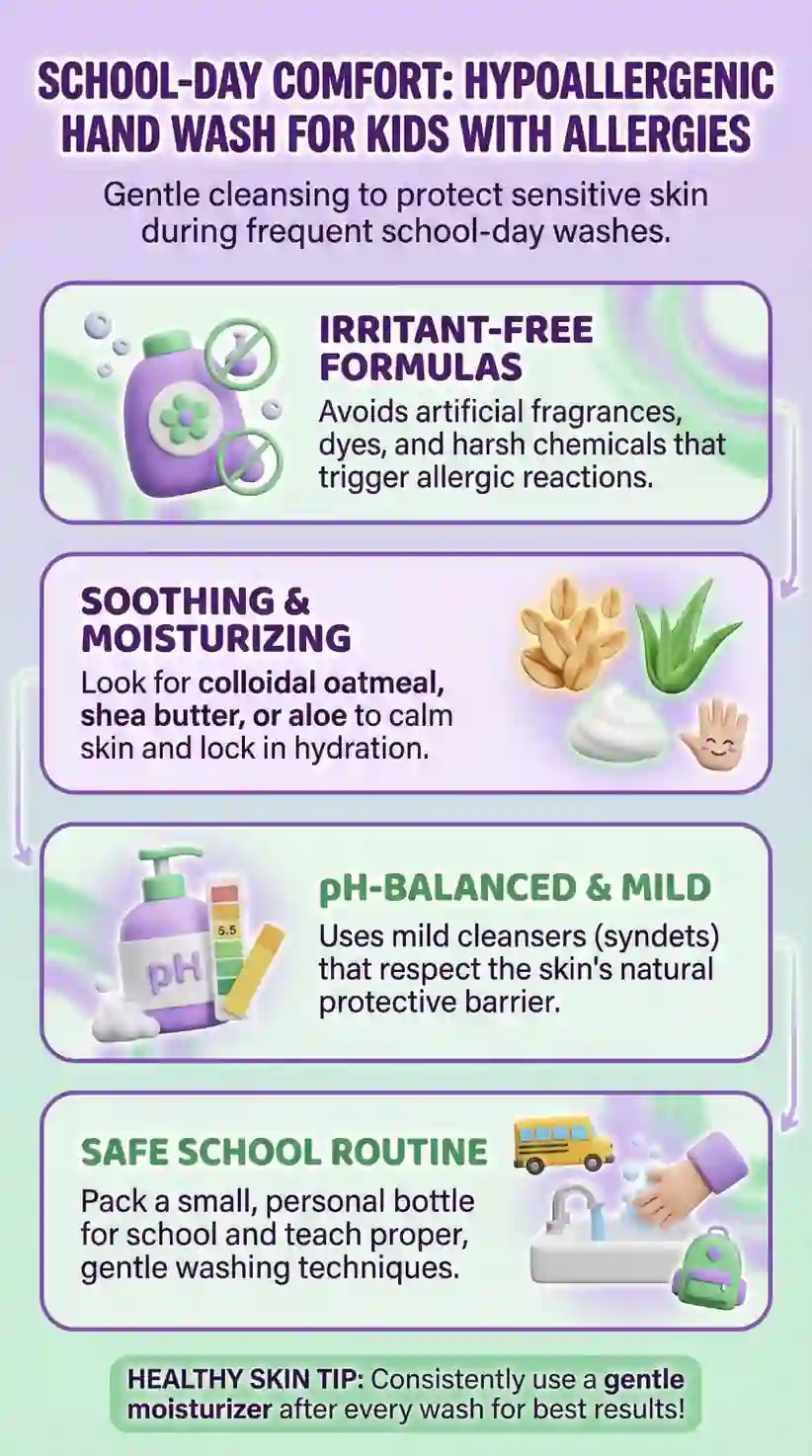
FAQ on Hypoallergenic Hand Wash for School-Age Children With Allergies
Q: What should I look for in a hypoallergenic hand soap for my child with allergies?
A: We asked this question for two years before we had an answer we trusted. Here is what formulating NOWATA for our own allergic children taught us that no label ever did.
What must be completely absent:
Synthetic fragrances — one "parfum" entry conceals 50 to 100 undisclosed allergens
SLS and SLES — strips the barrier and increases allergen penetration with every wash
Alcohol and ethanol — compounds barrier damage across every school-day wash
Parabens and formaldehyde-releasing preservatives — second most common contact allergen group in children
Artificial dyes — no functional benefit, documented irritation risk for reactive skin
Alkaline pH above 6 — disrupts the acid mantle protecting skin between washes
What must be independently verified — not self-declared:
Third-party laboratory testing with a named protocol — ASTM E1174 or equivalent
Results for both bacteria and virus removal — not assumed, verified
Full ingredient transparency — every compound disclosed, no hidden entries
What we added as non-negotiable after our daughter's skin kept reacting:
Elimination of wet-dry cycle — the trigger no formula change alone can address
Physical germ removal — nothing left on skin to transfer or continue irritating
No water required — effective at every point in the school day
The standard we apply: if we would not use it on our own children without reading every ingredient first — it does not belong in any child's hands.
Q: Is the soap in my child's school bathroom safe for kids with skin allergies?
A: Almost certainly not. This is the gap we never thought to investigate until our daughter started coming home with red, irritated hands every single day.
What we found when we investigated her school soap:
Bulk institutional formula purchased on lowest-bid procurement contracts
Synthetic fragrance — the number one cause of contact dermatitis in children — in every formula we reviewed
SLS in virtually every bulk institutional soap available for school procurement
Parabens in formulas carrying hypoallergenic front-label claims
No ingredient disclosure posted at any dispenser
No federal requirement to provide an allergy-safe alternative
Educators who cared deeply about our daughter — with no idea bathroom soap was triggering her skin six times a day
What the data confirms:
Allergic contact dermatitis affects 14.5% to 20% of children
Fragrance is consistently the leading contact allergen in children
Nearly 1 in 4 school-age children has a documented allergy
Peak eczema prevalence: children ages 6 to 11 — the highest mandatory handwashing years
What parents can do right now:
Request the ingredient list — not the product name — of every student-accessible dispenser
Cross-reference against the American Contact Dermatitis Society Core Allergen Series
Document school versus home reaction patterns — the contrast tells an important story
Request formal allergy accommodation and provide a verified alternative your child can carry
We managed our daughter's allergies carefully at home. A school soap dispenser undid all of it by dismissal. The dispenser is outside your control. What your child carries is not.
Q: Can my allergic child carry their own hand soap to school?
A: Yes — and for children with documented skin allergies this is currently the most reliable protection available in any institutional setting.
What the institutional reality looks like:
No federal requirement exists for schools to provide allergy-safe hand soap
School dispensers refilled with bulk formulas without allergy input
A child with a documented fragrance allergy has no guaranteed protection in a school bathroom
The only reliable protection is a verified alternative the child controls independently
What we carry for our own children — and why:
NOWATA in every backpack, lunchbox, and classroom supply kit
No water required — clean hands at every point in the school day without the bathroom dispenser
Zero synthetic fragrances, SLS, alcohol, parabens, and dyes — verified by ingredient list not front-label claim
Compact enough for a backpack or desk — accessible wherever hand hygiene is needed
What that independence changed for our daughter:
She stopped avoiding hand hygiene because it hurt
She had a verified alternative she controlled — not a dispenser she had no say over
Clean hands stopped being a trigger and started being a solution
The school bathroom is not your environment to control. What your child carries into it is.
Q: How does handwashing frequency at school affect my child's skin allergies?
A: This is the question that reframed everything for us — and the one we wish someone had asked before our daughter's first week of school.
What NIH peer-reviewed research confirmed:
Handwashing frequency is an independent risk factor for hand eczema — separate from soap chemistry
8 to 10 daily washes: 51% increased hand eczema risk — regardless of soap type
School-age children reach that threshold before dismissal
Each wet-dry cycle compounds barrier damage of the previous one before recovery can begin
What the school-day damage cycle looked like for our daughter:
We managed her skin carefully every morning with products we had researched and trusted
A single school day undid that management completely
Wash one stripped the barrier
Wash two found less barrier than wash one left
Wash six found almost none
She came home with six compounded reactions — not one
Frequency multiplies the problem
School is where frequency is highest and soap quality is lowest simultaneously
What this means for parents who have already switched to a gentler soap:
Gentler formula addresses chemical irritation
Does not address mechanical barrier damage across six daily wash-and-dry cycles
No formula alone resolves damage compounding across that many daily repetitions
The wet-dry cycle is the trigger — every traditional soap still requires it
What finally worked — and what we built NOWATA around:
Eliminating every known sensitizer — necessary but not sufficient
Eliminating the wet-dry cycle with waterless clumping technology — addressed the trigger no formula change could reach
Both changes required simultaneously
Neither alone was enough
No product on any shelf delivered both at once — so we built it
Q: What is the safest hand soap option for a child with multiple allergies at school?
A: After two years of formulation research and raising an allergic child through the school years, here is the honest answer — and why we had to build it ourselves.
Why no current school bathroom soap meets the standard:
Institutional soap is a cost decision — allergic child safety is not a selection criterion
No federal standard requires schools to exclude the most common childhood contact allergens
Fragrance, SLS, and parabens are present in virtually every bulk institutional formula
"Hypoallergenic" on any school soap label has never required a single clinical test to print
Formula — what must be completely absent:
Zero synthetic fragrances — no "parfum" concealing undisclosed compounds
Zero SLS — no primary irritant compromising the barrier before secondary allergens penetrate
Zero alcohol, parabens, and artificial dyes
pH-balanced between 4.5 and 5.5
100% plant-based with full ingredient transparency
Verification — what must be independently confirmed:
Third-party laboratory testing — ASTM E1174 or equivalent medical-grade protocol
99.9% verified removal of bacteria and viruses
Tested on reactive skin — not extrapolated from adult skin data
Mechanism — what the formula must do differently:
No water required — eliminates the wet-dry cycle and compounding school-day damage entirely
Physical germ removal — nothing left on skin to transfer or continue irritating
Portable — accessible at every handwashing point without a dispenser
Why we had to build this ourselves:
Our daughter has multiple sensitivities
We could not find a single product meeting all three requirements simultaneously
The answer did not exist — so we built it
Every batch still tested on our own children before anyone else's
The safest hand soap for a multi-allergic child at school eliminates every known trigger, carries independent verification, and never requires the institutional dispenser at all. Until schools are required to meet that standard themselves — the answer is what your child carries in their backpack.