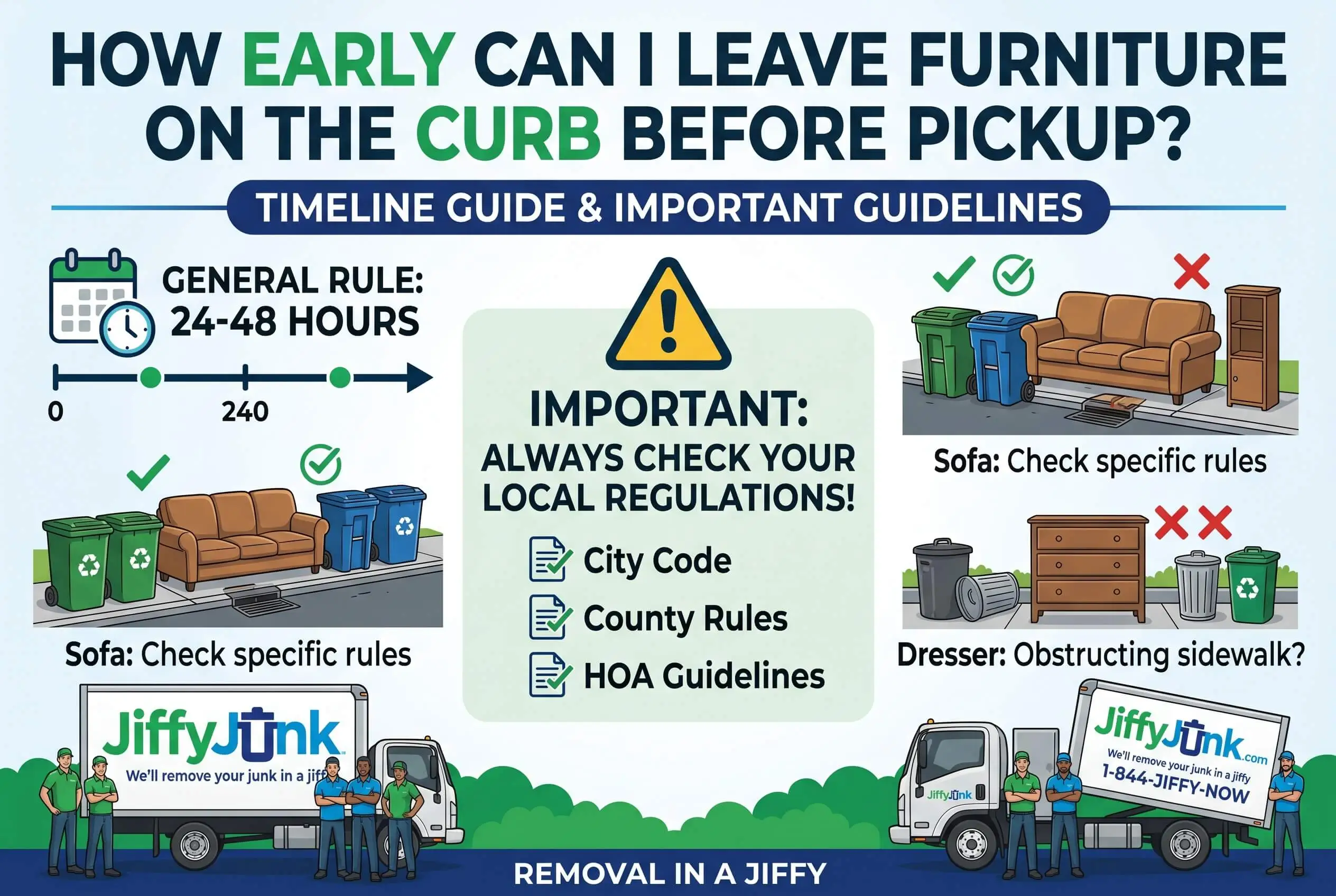
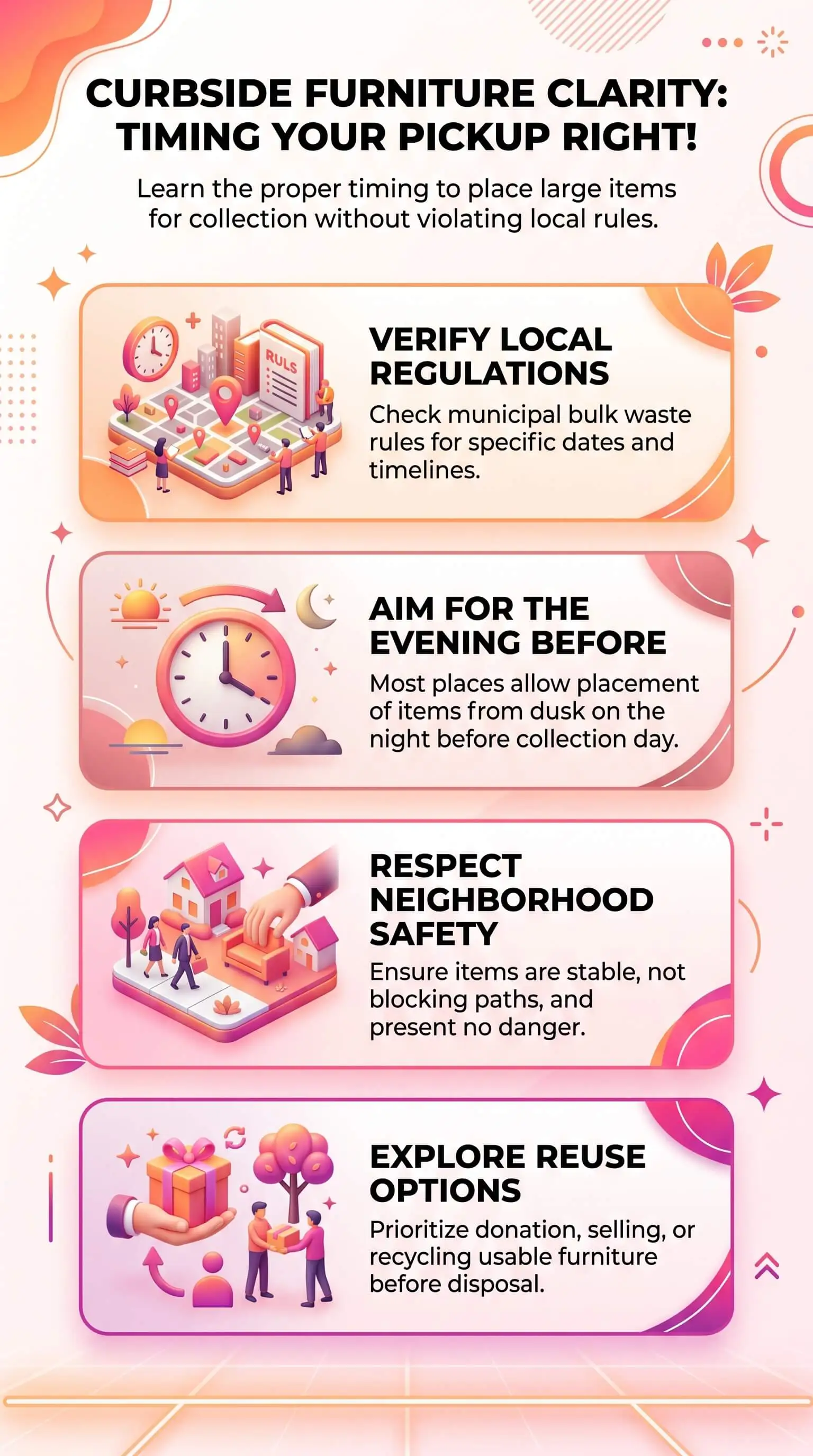
Most municipalities open the set-out window between 4 PM and dusk the night before pickup. Some tighten that to the morning of pickup itself. A few will fine you for putting the item out earlier than allowed even when the hauler runs a day late, but the good news is that the answer to can I leave furniture on the curb is often yes when you follow the approved pickup window.
TL;DR Quick Answers
Can I leave furniture on the curb?
Yes, but only within your city's posted bulk pickup window. Most cities allow set-out the evening before scheduled pickup (after 4 PM or 6 PM) or the morning of pickup itself. Most US jurisdictions treat unscheduled curbside set-out as illegal dumping.
Key rules:
Schedule pickup first, then set the item out the morning of pickup rather than the night before — the morning-of approach avoids weather damage, neighbor pile-ons, and rodent issues
Fines range from $150 in Seattle to $10,000 under California Penal Code 374.3, depending on jurisdiction and offense count
Most cities categorize furniture and construction debris separately, so staging a sofa next to torn-out concrete or hardscape material can void the bulk pickup entirely
Donation through Habitat for Humanity ReStore is the strongest alternative for furniture in usable condition
Top Takeaways
• Most cities permit curbside furniture set-out within 12 to 24 hours of scheduled pickup, with the night before pickup day being the typical earliest window.
• Putting furniture out earlier than the allowed window can trigger fines that range from $150 in cities like Seattle to $10,000 under California Penal Code 374.3, depending on jurisdiction and offense count.
• Scheduled bulk pickup, on-demand bulk pickup, and unscheduled curbside disposal each carry separate scheduling rules and very different penalties.
• Donation through Habitat for Humanity ReStore or a similar nonprofit is the strongest disposal path for any furniture in usable condition.
• When municipal pickup windows do not fit your timeline, on-demand haul-away services remove the timing constraint entirely.
What “How Early” Actually Means in Most Cities
US municipalities use one of three set-out windows. Evening-before windows open after 4 PM or 6 PM the day before pickup, and they dominate older East Coast cities. Morning-of-windows require set-out before 7 AM on pickup day with nothing earlier permitted, and they show up more in the Pacific Northwest and parts of the Midwest. Appointment-tied windows let the hauler dictate the set-out window when you book the pickup, which is the standard approach in newer Sun Belt cities.
New York City, for example, permits set-out after 4 PM the evening before collection day. Seattle's morning-of approach runs through Seattle Public Utilities. Phoenix and several other Sun Belt municipalities run appointment-only bulk pickup. The patterns are regional, not random.
If your municipality publishes a bulk waste or bulky item page on its sanitation department site, that page is the source of truth. Generic search results often mislead because rules vary block by block in some cities. Some neighborhoods have additional restrictions tied to historic district codes or HOA agreements, and those override whatever the city allows by default.
The Pickup Models You Will Actually Encounter
What looks like a single curbside pickup service is actually three different services with different rules and very different legal exposure.
1. Scheduled bulk pickup runs on a calendar set by the city, often quarterly or monthly. You wait for your scheduled window and follow the set-out timing rules.
2. On-demand bulk pickup lets you call or book online for a one-off pickup, often with a small fee. The hauler tells you the set-out window when you book.
3. Unscheduled curbside disposal means putting furniture out without any pickup arrangement and hoping a hauler takes it. Most jurisdictions classify this as illegal dumping, regardless of whether the item is yours and the curb sits in front of your own property.
The third category is where homeowners get fined. The first two are where the timing rules in this guide actually apply.
Why Putting It Out Too Early Backfires
Setting furniture out before your window opens creates four predictable problems. Code enforcement can cite you for illegal storage on the public right-of-way. Upholstery and wood get weather-damaged past the point of donation. Passersby pile their own items on top, which can trigger an illegal dumping investigation against you as the property owner. And rodents move into upholstered pieces within 48 hours, making proper bed bug furniture removal even more important when pests may already be a concern.
Three of those carry direct financial cost. The pest problem hides until you've already paid an exterminator.
“Years of cleaning up after hardscape demolitions taught me that municipal haulers draw a hard line between furniture and construction debris, and homeowners almost never know the difference matters until it costs them. A torn-out concrete patio sitting next to an old patio sofa looks like one debris pile to the homeowner. To the city, the sofa qualifies for bulk pickup and the concrete does not. Putting both at the curb the same evening can void the pickup entirely, and you end up paying to haul both yourself. Check the category your city uses before you set anything out.”
7 Essential Resources
These resources cover the federal data, municipal codes, and donation pathways that shape how curbside furniture disposal actually works. Bookmark the ones for your jurisdiction.
4. EPA Durable Goods: Product-Specific Data. National data on furniture and bulky item generation, recycling, and landfill flow, sourced directly from the federal agency that tracks the waste stream.
5. EPA Guide to the Facts and Figures Report on Materials, Waste and Recycling. Defines what counts as municipal solid waste versus construction debris, useful when you stage both furniture and renovation material at the curb.
6. NYC 311 Illegal Dumping Guidance. Direct municipal guidance on what counts as illegal dumping in the largest US bulk-pickup market, with reporting and complaint procedures.
7. Seattle SDCI Junk Storage and Illegal Dumping Rules. Specific first-time and repeat penalty amounts plus reporting channels, and the source for the Seattle fine figures cited in the Statistics section below.
8. Los Angeles County CleanLA Illegal Dumping Resources. California penal code citations and bulky-item pickup scheduling guidance, authoritative for west-coast jurisdictions across LA County.
9. EPA Sustainable Materials Management Hub. The top-level federal hub for furniture waste data, with year-over-year trend reports and national disposal flow figures.
10. Habitat for Humanity ReStore Locator. Donation alternative for furniture in usable condition, which closes the disposal-versus-donation loop for items that should not go to landfill.
3 Statistics
Federal agencies and state penal codes are the primary sources for the figures below. Each was verified at the time of writing.
• Americans generated 12.2 million tons of furniture waste in 2017, and 80.2 percent of it went to landfill, according to EPA Sustainable Materials Management data. The figure shows the scale of the curbside furniture flow and explains why municipalities take set-out timing seriously.
• Seattle issues a $150 fine for first-time improper junk storage and illegal curbside dumping, rising to $500 for repeat offenses, with higher amounts in designated zones, under Seattle's municipal code. The numbers translate the timing rules into actual cost.
• California Penal Code 374.3 authorizes fines of up to $10,000 for illegal dumping of waste matter on public or private property, with commercial-quantity violations reaching the maximum on a third offense. The figure marks the upper bound of penalty exposure for homeowners who treat curbside set-out as informal.
Final Thoughts and Opinion
The homeowners I have worked with on hardscape and yard cleanup projects who avoided fines and missed pickups were almost always the ones who set bulky items out the morning of pickup, never the night before. My honest opinion: schedule the pickup and place the item out the same morning, regardless of what your city technically allows.
Evening-before set-outs are convenient. They also invite weather damage to anything upholstered, attract piggyback dumping from neighbors who notice the curbside pile, and turn a 12-hour wait into a two-week pest problem when haulers run behind. The fine you save by squeezing into a generous timing window is rarely worth the risk of a missed pickup.
Cities do not punish punctuality. Setting an item out at 6 AM on pickup day costs nothing but a slightly earlier alarm. Setting it out at 6 PM the night before puts you on the hook for citations, weather damage, dumping piggybacks, and rodents.
When the municipal window doesn't fit your timeline, professional curbside furniture pickup and haul-away services remove the timing constraint. You set the appointment, the crew shows up in the window you specify, and the curb stays clear in between. For renovation timelines or estate cleanouts where city schedules will not flex, the on-demand model is usually the better tradeoff. The same logic applies when the project mixes furniture with yard debris or hardscape demolition material, since municipal haulers handle those categories on separate schedules.
Frequently Asked Questions
How many hours before pickup can I put furniture on the curb?
Most cities permit set-out 12 to 18 hours before scheduled pickup, with windows that usually open after 4 PM the evening before. A few municipalities tighten this to morning-of, with no set-out earlier than 6 or 7 AM on pickup day. Check your city's bulk waste page for the exact window before you set anything out.
What happens if I leave furniture on the curb without scheduling pickup?
Most US jurisdictions treat unscheduled furniture set-out as illegal dumping. Code enforcement can issue a citation, the item can sit indefinitely without ever being collected, and you remain responsible for removal and any cleanup costs. Schedule the pickup first, then set the item out within the window the hauler specifies.
Can I be fined for leaving a couch on the curb?
Yes. Cities issue fines for early set-out, late retrieval of items haulers refuse, and unscheduled curbside disposal. Seattle starts at $150 for first violations and rises to $500 for repeats. California's Penal Code 374.3 allows fines of up to $10,000 for illegal dumping. Specific amounts vary by city and offense count, so the safe move is to follow your municipality's posted timing rules.
Will the city pick up any furniture for free?
Many cities include a set number of bulk pickups per year in standard residential trash service, though some charge per item or per appointment. Items must usually be in collectible condition: free of hazardous materials, not soaking wet, and within the size and weight limits the hauler publishes. Check whether your municipality charges a bulk fee before scheduling.
What should I do if my furniture is still at the curb after the scheduled pickup time?
Pull it back onto your property the same day. Items left past the window become your responsibility, and code enforcement can cite you for storage in the public right-of-way. Call the sanitation department to find out why the pickup was missed, then schedule a recovery pickup or arrange on-demand haul-away if the city cannot reschedule quickly.
Are there alternatives to leaving furniture on the curb?
A few alternatives often beat curbside. Donation to Habitat for Humanity ReStore or a similar nonprofit handles items in usable condition. On-demand junk removal services pick up the same day or next day on a window you choose. Posting on local resale or freecycle networks moves items quickly when the piece has any remaining value.
Call to Action
When the municipal window doesn't fit your project timeline, book a same-week haul-away and skip the curbside scheduling entirely. Comment with the rules in your city. Share with a neighbor who's renovating. And if outdoor maintenance posts are your thing, subscribe for more from Hard Landscaping.